

Aizome, Kasuri, Kofu: A Guide to Japanese Indigo Textiles

Before synthetic dyes. Before industrial looms. Before the idea of disposable clothing. There was indigo.
For over a thousand years, the farmers, weavers, and dyers of Japan worked with a single plant — Persicaria tinctoria, known in Japanese as ai — to produce cloth of extraordinary depth, durability, and beauty. The result was not one tradition but many: aizome, kasuri, kofu, and the countless regional variations that grew from the same blue root.
Today, collectors in New York, Paris, and London are paying serious attention to Japan vintage indigo textiles. The slow fashion movement has created a new kind of buyer — someone who wants clothing with genuine history, genuine craft, and genuine singularity. Japanese indigo offers all three. And the best pieces are becoming harder to find every year.
This is your complete guide.
What Is Aizome?

Aizome (藍染め) is the Japanese tradition of dyeing with natural indigo — one of the oldest and most refined dyeing practices in the world. The word breaks down simply: ai (藍) is the indigo plant; zome (染め) means dyeing.
The indigo plant was cultivated across Japan, with particularly strong traditions in Tokushima (formerly Awa Province), Aichi, and the Tohoku region. The leaves were harvested, composted into a fermented dye base called sukumo, and used to dye cotton, hemp, and silk through a process of repeated immersion and oxidation. Each dip added depth. Each exposure to air fixed the color. The result — after dozens of immersions — was the deep, saturated blue that defines Japan vintage indigo.
Aizome was not merely aesthetic. Indigo-dyed cloth has practical properties that made it essential for workwear: the dye repels insects, has mild antibacterial qualities, and — crucially — strengthens cotton fiber over time. A well-worn aizome garment becomes more beautiful with age, the color fading in patterns that record the life of the cloth.
This is why aizome indigo stripe fabric is now among the most sought-after materials in the Japan vintage market. The fading is not damage. It is evidence.
What Is Kasuri?

Kasuri (紣) is a resist-dyeing technique in which threads are bound and dyed before weaving, creating a characteristic soft-edged, blurred pattern when the cloth is woven. It is known in the West as ikat — a term derived from the Malay word for bind.
In Japan, kasuri developed independently and reached extraordinary levels of refinement. The binding of threads before dyeing requires precise calculation: the weaver must know exactly where each thread will sit in the finished cloth, and bind accordingly. The result — when the threads are woven — is a pattern that appears to float slightly out of focus, as if seen through water or morning mist.
Kasuri patterns in Japan vintage textiles range from simple geometric forms to complex pictorial designs:
- Igeta kasuri — a well-frame diamond grid, one of the oldest and most enduring patterns
- Yagasuri — arrow feather pattern, associated with good fortune and forward movement
- Hana kasuri — floral kasuri, more common in women's garments
- E-gasuri — pictorial kasuri, depicting landscapes, animals, or narrative scenes
The finest kasuri work — particularly the pictorial e-gasuri of the Meiji and Taisho eras — required months of preparation for a single length of cloth. These pieces are now museum-quality objects.
In workwear, kasuri appears most often in noragi jackets and monpe work pants — the everyday garments of rural Japan, worn hard and repaired when they wore through.
What Is Kofu?

Kofu (古布) means literally "old cloth" — ko (古) meaning old or ancient, fu (布) meaning cloth or fabric. In the context of Japan vintage textiles, kofu refers to antique Japanese fabric: cloth that has survived from the Edo, Meiji, Taisho, or early Showa periods, valued for its age, its fiber quality, and the dyeing and weaving traditions it embodies.
Kofu is not a specific technique or pattern — it is a category. A piece of kofu might be plain-weave indigo cotton, a complex kasuri, a striped hemp, or a fragment of silk. What defines it is age and authenticity: the particular hand of cloth made before synthetic fibers, before chemical dyes, before the industrialization of Japanese textile production.
Collectors of kofu are looking for several things: the quality of the fiber (hand-spun cotton has a different character from machine-spun), the depth of the natural dye, the evidence of hand-weaving in the selvedge and the slight irregularities of the weave, and the patina of genuine age — the softness, the fading, the texture that no new fabric can replicate.
The Three Great Indigo Fabric Traditions
Shima — Stripe

Stripe is one of the oldest and most enduring patterns in Japanese textile history. In indigo workwear, stripes appear in every combination of width, spacing, and color — from the bold alternating stripes of Tohoku noragi to the fine pinstripes of urban merchant clothing. The stripe was not decoration; it was structure, following the warp of the loom and the logic of the weave. Indigo stripe noragi from the 1930s–1950s represent the peak of this tradition.
Kasuri — Ikat
The indigo kasuri noragi is the garment that most completely embodies the kasuri tradition — a jacket made from cloth that required extraordinary skill to produce, worn by people who valued durability above all else.
Muji — Plain Weave
Plain-weave indigo cotton — solid, unpatterned, dyed to a deep and even blue — is the rarest and most prized category in the Japan vintage market. The absence of pattern places all the emphasis on the quality of the fiber and the depth of the dye.
Indigo Workwear: The Garments
Noragi — The Field Jacket
The noragi (野良着) is the defining garment of Japan vintage indigo workwear. A loose-fitting jacket with wide sleeves and a straight body, worn by farmers, fishermen, and craftspeople from at least the Edo period through the mid-20th century. Indigo stripe noragi are the most common form; kasuri noragi with tenugui linings are among the most sought-after.
Monpe — The Work Pants

Monpe (もんぷ) are the traditional work pants of rural Japan — wide-legged, gathered at the ankle, made from the same indigo cotton as noragi. Indigo kasuri monpe with double-knee reinforcement are particularly prized. Boro monpe — extensively patched and repaired — are among the most extraordinary objects in the Japan vintage market.
Momohiki — The Indigo Work Trousers

Momohiki (股引) are close-fitting work trousers — the indigo counterpart to the loose monpe. Worn by craftsmen, carpenters, and festival participants, momohiki have a distinctive tapered silhouette that translates naturally into contemporary wardrobes.
Boro — The Repaired Textile
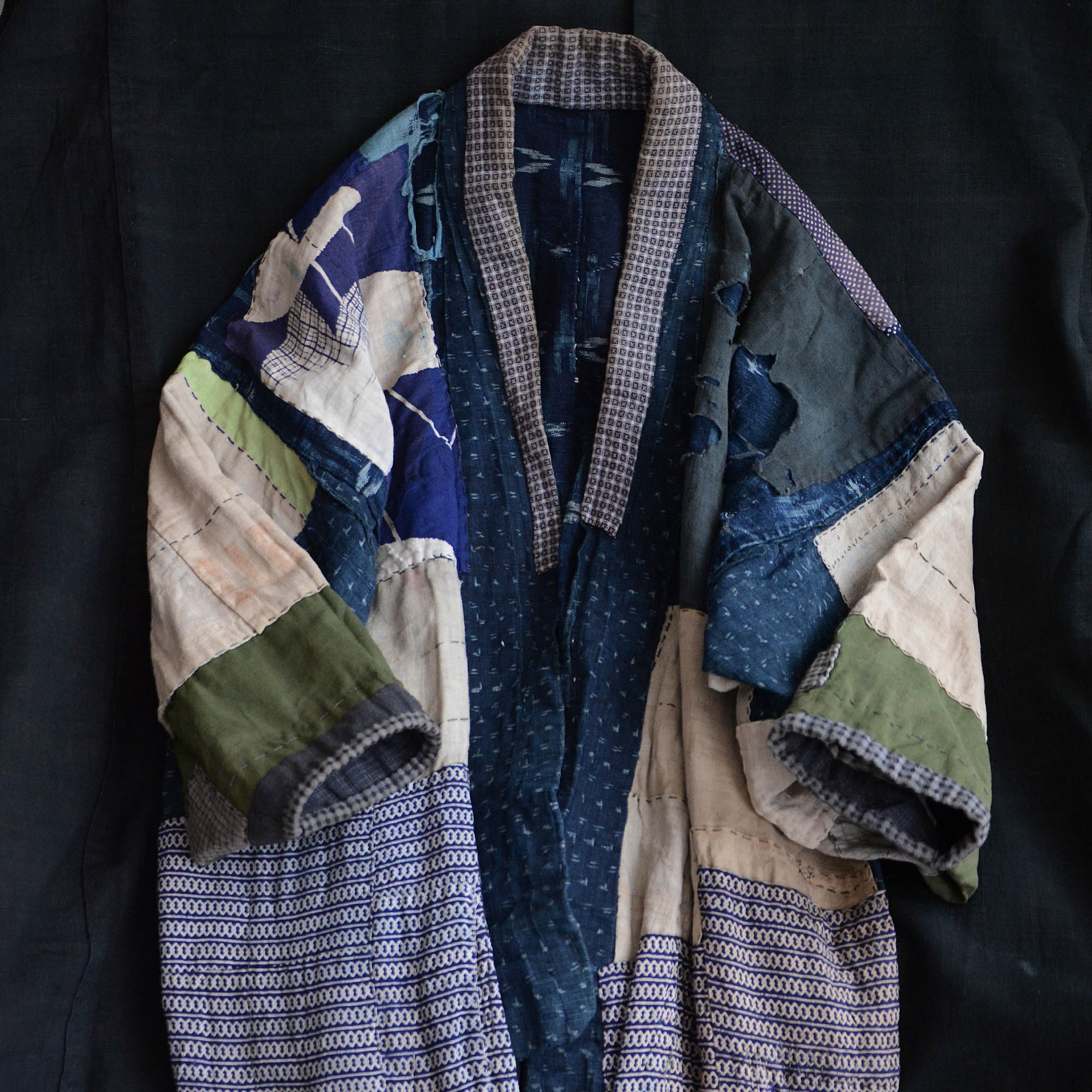
Boro (ボロ) refers to Japanese textiles that have been patched, mended, and reinforced across years, decades, sometimes generations. In the context of indigo workwear, boro is not damage — it is evidence of value.
Why Japan Vintage Indigo Now?

The global slow fashion movement has given collectors and buyers a language for what they already felt: that a garment with genuine history is worth more than a garment without one. That craft matters. That singularity matters. That the marks of time are not flaws to be corrected, but a record to be read.
Japanese indigo textiles embody all of this. They were made to last. They were repaired when they wore out. They were passed down, used up, and finally preserved by the accident of survival. Every piece that exists today is a piece that made it through — through decades of use, through the transition from traditional to Western dress, through the attics and tansu chests of rural Japan.
The supply is finite. The best pieces are becoming harder to find every year. And the world is finally paying attention.
Explore Our Indigo Collection
At NAMBA SHOUTEN, every indigo piece we offer has been individually sourced, inspected, and documented. We photograph the fabric, the construction, the repairs, and the details — because the details are the point.
Related Articles
- Noragi: The Japanese Farmer's Jacket That Slow Fashion Has Been Waiting For
- Boro: The Japanese Art of Repair That the World Is Finally Seeing
- Haori: The Japanese Kimono Jacket That the World Is Just Discovering
- Japan Vintage Textile: The Aizome Indigo Stripe Fabric That Collectors Are Chasing
- Momohiki: The Indigo Work Pants That Outlasted Centuries
Frequently Asked Questions About Japanese Indigo Textiles
What is aizome?
Aizome (藍染め) is the Japanese tradition of dyeing with natural indigo — one of the oldest dyeing practices in the world. The indigo plant (Persicaria tinctoria) was cultivated across Japan and used to dye cotton, hemp, and silk through repeated immersion and oxidation. Aizome cloth is prized not only for its deep blue color but for its practical properties: the dye repels insects, has mild antibacterial qualities, and strengthens cotton fiber over time.
What is kasuri?
Kasuri (紣) is a Japanese resist-dyeing technique in which threads are bound and dyed before weaving, creating a characteristic soft-edged, blurred pattern in the finished cloth. Known in the West as ikat, kasuri patterns range from simple geometric forms (diamond grids, arrow feathers) to complex pictorial designs. The finest kasuri work required months of preparation for a single length of cloth.
What is kofu?
Kofu (古布) means "old cloth" — antique Japanese fabric from the Edo, Meiji, Taisho, or early Showa periods. It is not a specific technique but a category: cloth valued for its age, fiber quality, and the dyeing and weaving traditions it embodies. Collectors of kofu look for hand-spun fiber, natural dye depth, evidence of hand-weaving, and the patina of genuine age.
What is the difference between noragi and monpe?
Both are traditional Japanese workwear made from indigo-dyed cotton, but they are different garments. Noragi (野良着) is a loose-fitting jacket — the upper-body workwear of rural Japan. Monpe (もんぷ) are wide-legged work pants, gathered at the ankle, worn primarily by women in the fields and workshops of Meiji, Taisho, and Showa Japan. Both were repaired extensively and are now highly collectible.
Why is Japan vintage indigo so valuable?
Japan vintage indigo textiles are valuable because they are finite and irreplaceable. The conditions that produced them — natural indigo cultivation, hand-spinning, hand-weaving, traditional dyeing — no longer exist at any significant scale. Every piece that survives is a primary document of Japanese material culture. Global demand from collectors, fashion designers, and museums continues to grow while supply shrinks every year.
How do I identify authentic Japan vintage indigo?
Authentic Japan vintage indigo shows genuine age in the dye: fading at points of wear, deeper color in protected areas, a patina that cannot be faked. The fiber has the particular hand of aged cotton — soft, slightly stiff, with a texture that no new fabric replicates. Construction is hand-sewn or early machine-sewn. Repairs, if present, are functional rather than decorative.